Endothelial cells are the thin, specialized cells that line the interior surface of all blood and lymphatic vessels. They form a continuous, dynamic interface between circulating blood and the vessel wall, and their health underpins the function of nearly every organ. As a semi-permeable layer, endothelial cells regulate vascular tone, maintain blood fluidity and clotting, orchestrate immune cell trafficking, and drive angiogenesis and repair. Endothelial dysfunction is a key driver of major diseases including atherosclerosis, hypertension and cancer.
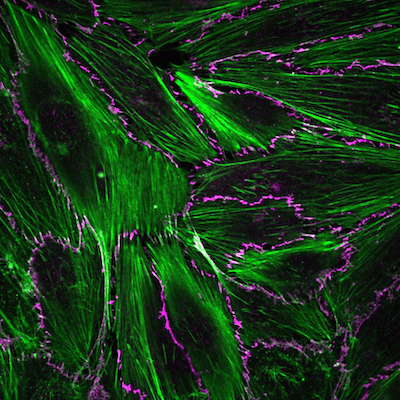 Our vision is to decode, predict, and engineer disease-relevant mechano-responses of the endothelium. The biological questions that motivate us include: how does the endothelium sense and respond to mechanical forces, including fluid shear stress, stretch, and substrate curvature? How does mechanosensing mediate cardio- and cerebrovascular function, and how does mechanosensing go awry to drive diseases? We will provide crucial mechanistic insight into how long timescale, force-dependent gene expression drives rapid biochemical signaling and phenotypical behaviors to ultimately tune vascular tissue function across scales. Decoding these precise mechano-chemical feedback loops will help establish models to tune tissue function and bridge the gap between the fields of biology and medicine.
Our lab focuses on two fundamental themes incorporating both experimental and modeling approaches: 1) decoding the precise mechanobiology of vascular function in cardio- and cerebro-vascular diseases, and 2) domain-tailored predictive modeling and control of tissue mechanoresponses in disease. The overarching theme is to map how transcriptional status and local cellular events precisely define tissue behavior and function across scales. Using in vitro approaches as well as patient heart tissues, and leveraging advanced high-resolution microscopy, multi-omics approaches, biochemistry, and bioengineering tools, we will decode the mechano-chemical feedback loops driving vascular tissue dysfunction and establish models to tune them. This will allow us to engineer adaptive tissues to tune physiology and enable targeted interventions in diseases where biological systems go awry.