Understanding the molecular basis for mechanotransduction
In cells and tissues, the integration and propagation of mechanical signals is facilitated by the activity of molecular machines; small groups of proteins that detect and respond to mechanical stimuli by transferring physical forces to other cellular components, or facilitating their conversion to biochemical signals.
The information obtained during this process, which is known as mechanosensing, helps in cellular decision making.This is particularly important during development, when stem cells are differentiating to become specific cell types, and during wound healing or tissue repair.
Cells can measure the stiffness of the surface on which they are growing and they can detect and respond to tension from neighboring cells within a tissue. Understanding how individual cells and proteins contribute to the mechanotransduction of physical force, is a major focus in the research conducted at the MBI. Dissecting the nanoscale architecture of various molecular machines involves the manipulation of specific cellular components, and at times, single proteins or specific protein domains. We can then monitor any subsequent effects.
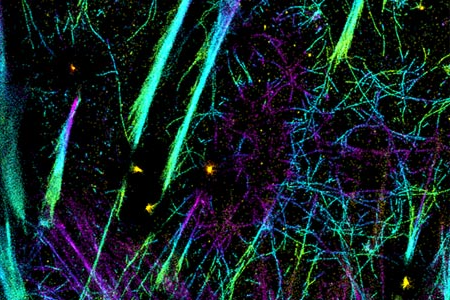
Crucial to these efforts is the ability to control and modify the physical parameters of the cellular microenvironment. This means growing cells on substrates of a specific stiffness, pattern or shape. The effect of any molecular manipulation must then be monitored by quantifying the forces generated by cells or individual proteins, or visualizing the effects using super-resolution microscopy techniques.

At MBI, we investigate how groups of proteins come together to form modular functional units that are capable of mediating diverse cellular functions by sensing and relaying mechanical signals between various components of the cell.
More MBI video articles and features.
By
Published through Cambridge University Press and available in March of 2018, MBI Principal Investigators Michael Sheetz and Hanry Yu have written a unique introductory text explaining cell functions using the engineering principles of robust devices. Adopting a process-based approach to understanding cell and tissue biology, the book describes the molecular and mechanical features that enable the cell to be robust in operating its various components, and explores the ways in which molecular modules respond to environmental signals to execute complex functions.