
[fusion_builder_container hundred_percent=”no” equal_height_columns=”no” hide_on_mobile=”no” background_color=”#3d89b5″ background_position=”left top” background_repeat=”no-repeat” fade=”no” background_parallax=”none” enable_mobile=”no” parallax_speed=”0.3″ video_aspect_ratio=”16:9″ video_loop=”yes” video_mute=”yes” border_size=”0px” border_style=”solid” margin_top=”0px” margin_bottom=”0px” padding_top=”0px” padding_bottom=”0px” admin_toggled=”yes”][fusion_builder_row][fusion_builder_column type=”1_1″ layout=”1_1″ background_position=”left top” background_color=”” border_size=”” border_color=”” border_style=”solid” spacing=”yes” background_image=”” background_repeat=”no-repeat” padding_top=”” padding_right=”” padding_bottom=”” padding_left=”” margin_top=”0px” margin_bottom=”0px” class=”” id=”” animation_type=”” animation_speed=”0.3″ animation_direction=”left” hide_on_mobile=”no” center_content=”no” min_height=”none” last=”no” hover_type=”none” link=”” border_position=”all”][fusion_text] [/fusion_text][/fusion_builder_column][/fusion_builder_row][/fusion_builder_container][fusion_builder_container background_color=”#adc1ca” background_parallax=”none” enable_mobile=”no” parallax_speed=”0.3″ background_repeat=”no-repeat” background_position=”left top” video_aspect_ratio=”16:9″ video_mute=”yes” video_loop=”yes” fade=”no” border_size=”0px” border_style=”solid” padding_top=”0px” padding_bottom=”0px” hundred_percent=”yes” equal_height_columns=”no” hide_on_mobile=”no” admin_toggled=”yes”][fusion_builder_row][fusion_builder_column type=”1_1″ layout=”1_1″ background_position=”left top” background_color=”” border_size=”” border_color=”” border_style=”solid” spacing=”yes” background_image=”” background_repeat=”no-repeat” padding_top=”” padding_right=”” padding_bottom=”” padding_left=”” margin_top=”0px” margin_bottom=”0px” class=”” id=”” animation_type=”” animation_speed=”0.3″ animation_direction=”left” hide_on_mobile=”no” center_content=”no” min_height=”none” last=”no” hover_type=”none” link=”” border_position=”all”][fusion_button link=”/news/” color=”custom” size=”small” stretch=”no” target=”_self” button_gradient_top_color=”#adc1ca” button_gradient_bottom_color=”#adc1ca” accent_color=”#ffffff” border_width=”0px” icon=”fa-home” icon_position=”left” icon_divider=”no” animation_type=”0″ animation_direction=”left” animation_speed=”1″ border_color=”#ffffff”]MBInsights Home[/fusion_button][fusion_button link=”/category/science-features/” color=”custom” size=”small” stretch=”no” target=”_self” button_gradient_top_color=”#adc1ca” button_gradient_bottom_color=”#adc1ca” accent_color=”#ffffff” icon=”fa-flask” icon_position=”left” icon_divider=”no” animation_type=”0″ animation_direction=”left” animation_speed=”1″ border_radius=”2″ border_color=”#ffffff”]Science Features[/fusion_button][fusion_button link=”/category/news/” color=”custom” size=”small” stretch=”no” target=”_self” button_gradient_top_color=”#adc1ca” button_gradient_bottom_color=”#adc1ca” accent_color=”#ffffff” icon=”fa-bullhorn” icon_position=”left” icon_divider=”no” animation_type=”0″ animation_direction=”left” animation_speed=”1″ border_color=”#ffffff”]News[/fusion_button][fusion_button link=”/category/awards/” color=”custom” size=”small” stretch=”no” target=”_self” button_gradient_top_color=”#adc1ca” button_gradient_bottom_color=”#adc1ca” accent_color=”#ffffff” icon=”fa-trophy” icon_position=”left” icon_divider=”no” animation_type=”0″ animation_direction=”left” animation_speed=”1″ border_radius=”2″ border_color=”#ffffff”]Awards[/fusion_button][fusion_button link=”/category/outreach/” color=”custom” size=”small” stretch=”no” target=”_self” button_gradient_top_color=”#adc1ca” button_gradient_bottom_color=”#adc1ca” accent_color=”#ffffff” border_width=”0px” icon=”fa-hand-paper-o” icon_position=”left” icon_divider=”no” animation_type=”0″ animation_direction=”left” animation_speed=”1″ border_color=”#ffffff”]Outreach[/fusion_button][fusion_button link=”/category/conferences-etc/” color=”custom” size=”small” stretch=”no” target=”_self” button_gradient_top_color=”#adc1ca” button_gradient_bottom_color=”#adc1ca” accent_color=”#ffffff” border_width=”0px” icon=”fa-calendar” icon_position=”left” icon_divider=”no” animation_type=”0″ animation_direction=”left” animation_speed=”1″ border_color=”#ffffff”]Events[/fusion_button][/fusion_builder_column][/fusion_builder_row][/fusion_builder_container][fusion_builder_container background_parallax=”none” enable_mobile=”no” parallax_speed=”0.3″ background_repeat=”no-repeat” background_position=”left top” video_aspect_ratio=”16:9″ video_mute=”yes” video_loop=”yes” fade=”no” border_size=”0px” padding_top=”20″ padding_bottom=”20″ hundred_percent=”no” equal_height_columns=”no” hide_on_mobile=”no”][fusion_builder_row][fusion_builder_column type=”2_3″ layout=”2_3″ last=”no” spacing=”yes” center_content=”no” hide_on_mobile=”no” background_color=”” background_image=”” background_repeat=”no-repeat” background_position=”left top” hover_type=”none” link=”” border_position=”all” border_size=”0px” border_color=”” border_style=”solid” padding_top=”” padding_right=”” padding_bottom=”” padding_left=”” margin_top=”40px” margin_bottom=”” animation_type=”0″ animation_direction=”down” animation_speed=”0.1″ animation_offset=”” class=”” id=”” min_height=””][fusion_button link=”/category/science-features/” color=”custom” size=”small” stretch=”no” target=”_self” button_gradient_top_color=”#ff6f00″ button_gradient_bottom_color=”#ff6f00″ border_width=”2px” icon_position=”left” icon_divider=”no” animation_type=”0″ animation_direction=”left” animation_speed=”1″ border_radius=”2″]Science Features[/fusion_button][fusion_separator style_type=”none” top_margin=”50px” alignment=”center” /][fusion_text columns=”” column_min_width=”” column_spacing=”” rule_style=”default” rule_size=”” rule_color=”” class=”” id=””]
Predicting mechanical lifetime
Modelling mechanosense and response
Edited by Andrew MS Wong, PhD. Illustration by Diego Pitta de Araujo, PhD | 30 Aug 2018
A research team led by Prof. Jie Yan, Principal Investigator at the Mechanobiology Institute (MBI) and Department of Physics, National University of Singapore has derived a new theoretical model to predict the force-dependent lifetime of protein domains or molecular complexes, based on the structural-elastic properties of the biomolecules involved. This model is capable of explaining highly complex experimentally measured mechanical lifetime data that has been reported for a variety of molecules, and can be applied to determine the transition state of biomolecules subjected to force. This study is published in Chemical Science as an Edge article, and was selected for the journal cover.
[/fusion_text][fusion_text columns=”” column_min_width=”” column_spacing=”” rule_style=”default” rule_size=”” rule_color=”” class=”” id=””]

[/fusion_text][fusion_text columns=”” column_min_width=”” column_spacing=”” rule_style=”default” rule_size=”” rule_color=”” class=”” id=””]
Mechanical lifetime is the foundation for mechanotransduction
Mechanotransduction is the ability of cells to sense the mechanical properties of their surroundings and convert that information into biochemical signals, which then direct how the cell responds; e.g. by changing its shape, differentiating into a specialised cell, or by initiating cell division. For this vital process to occur, the cell uses specialised force-bearing biomolecules which must be able to repeatedly receive and transmit mechanical force, and do so without losing structural stability, becoming damaged, or interfering with the mechanical signal. In cell biology, this is often carried out by proteins made up of multiple domains which are able to fold and unfold, allowing the protein to buffer the mechanical force. Adding to this complexity is that many mechanotransduction pathways involve multiple force-bearing proteins, which will need to form stable mechanical linkages and also unlink as necessary depending on the level of force.
With the advent of single-molecule manipulation technologies, it is now possible to perform experiments to ‘stretch’ individual mechanosensing proteins or protein-protein complexes. Such experiments can measure the responses of these proteins and protein-protein complexes to force, and quantify their mechanical lifetime. In contrast, theoretical modelling of the force-response has lagged behind experimental discoveries, primarily due to the complex transition kinetics involved. Many of the existing models are purely descriptive or empirical, lacking support from solid quantitative physical mechanisms. As a result, numerous single-molecule experiments have revealed that the actual transition kinetics of biomolecules can differ greatly from the predicted data obtained from current theoretical models.
[perfectpullquote align=”left” bordertop=”false” cite=”” link=”” color=”” class=”” size=””]A new theoretical model allows scientists to predict the mechanical lifetime of protein domains or complexes in response to force.[/perfectpullquote]
In one recent study, scientists from the lab of Prof. Jie Yan (MBI and Department of Physics, NUS) discovered that the immunoglobulin-like I27 domain of the muscle protein titin exhibits two distinct force-dependent behaviours of its mechanical lifetime. Titin I27 behaves like a catch bond (where the bond lifetime paradoxically increases as force increases) when subjected to force up to 22 pN, after which it behaves as a typical slip bond (where the bond lifetime decreases as the pulling force increases). Therefore, they revealed that titin I27 exhibits a mind-boggling catch-to-slip switching behaviour which cannot be understood by most current models.
Based on the elasticity and structure of I27 in its native folded state and in the transition state (i.e., the state corresponding to the energy barrier), the Yan lab subsequently demonstrated that this peculiar catch-to-slip switching behaviour of titin I27 can be fully explained by the difference of the structural-elastic properties of titin I27 between those two states. While this mechanism promises to be a generic explanation that accounts for the catch-to-slip switching behaviours often observed for mechanosensing proteins, its application requires prior knowledge of the structural-elastic properties of the proteins in their native and transition states. Unfortunately, the structural-elastic properties of the transition state of most of proteins or protein-protein complexes are unavailable, making it impossible to generalize this mechanism to explain experimental data.
Derivation of force-dependent lifetime based on molecular structural-elastic properties
Building on this previous breakthrough, the Yan lab have now derived an analytical expression to predict the mechanical lifetime for the transitions of biomolecules that utilises their structural-elastic properties of the native and transition states. In this derivation, the unknown properties of the transition state of the molecule become parameters that will be determined by fitting to experimental data. Specifically, the expression contains three parameters that are directly related to the different structural-elastic properties of the molecules between the transition and the native states.
Importantly, the expression can be applied to explain mechanical lifetime data for any biomolecule, without prior knowledge of their structural-elastic properties. Furthermore, the best-fitting values of the three parameters as determined by fitting to experimental data provides important insights into the structural-elastic properties of the molecules. Using this expression, it is possible to directly obtain the structural and elastic information of biomolecules in their transition state.
As the derivation of this new expression is based on the Arrhenius law without assuming any energy landscape underlying the transitions, the applications of the expression are not restricted by the details of the transition pathway, such as the shape or dimensionality of the underlying energy landscape. Combined, these features allow the model to be applied to a very wide scope of biomolecules and experiments. Remarkably, during the validation process the research team found that this model is able to fit the experimental data for a variety of different biomolecules, suggesting that there is an exquisite interconnection between the structural-elastic properties of a biomolecule and its force-dependent lifetime that has now been unveiled for the first time. Experimental observation of transition kinetics has already led to advances in understanding how DNA is coiled, the mechanics of actin filament elongation, and how certain proteins act as cellular shock absorbers. With this new theoretical model, scientists will now be able to predict the mechanical lifetime of mechanosensing proteins in advance of experimental confirmation, thereby increasing our knowledge of mechanotransduction pathways.
[/fusion_text][fusion_tagline_box backgroundcolor=”#eeeeee” shadow=”no” shadowopacity=”0.70″ border=”1″ bordercolor=”#eeeeee” highlightposition=”left” content_alignment=”left” link=”https://www.mechanobio.info/what-is-mechanobiology/how-do-cells-respond-to-mechanotransduction/” button=”Visit MBInfo” linktarget=”_self” modal=”” button_size=”” button_type=”” buttoncolor=”default” title=”More on Mechanotransduction” description=”TGVhcm4gbW9yZSBhYm91dCB0aGlzIHRvcGljIGF0IE1CaW5mbywgYSBjb21tdW5pdHkgb2YgaW50ZXJkaXNjaXBsaW5hcnkgcmVzZWFyY2hlcnMgYW5kIGFjYWRlbWljcyB3b3JraW5nIHRvIGRlZmluZSB0aGUgZmllbGQgb2YgTWVjaGFub2Jpb2xvZ3ku” margin_top=”” margin_bottom=”” hide_on_mobile=”small-visibility,medium-visibility,large-visibility” class=”” id=”” animation_type=”” animation_direction=”down” animation_speed=”0.1″ animation_offset=”” button_border_radius=””]

[/fusion_tagline_box][/fusion_builder_column][fusion_builder_column type=”1_3″ layout=”1_3″ last=”yes” spacing=”yes” center_content=”no” hide_on_mobile=”no” background_color=”” background_image=”” background_repeat=”no-repeat” background_position=”left top” hover_type=”none” link=”” border_position=”all” border_size=”0px” border_color=”” border_style=”solid” padding_top=”16px” padding_right=”16px” padding_bottom=”16px” padding_left=”16px” margin_top=”” margin_bottom=”” animation_type=”0″ animation_direction=”down” animation_speed=”0.1″ animation_offset=”” class=”sidebar-mbinsights” id=”” min_height=””][fusion_text columns=”” column_min_width=”” column_spacing=”” rule_style=”default” rule_size=”” rule_color=”” class=”” id=””]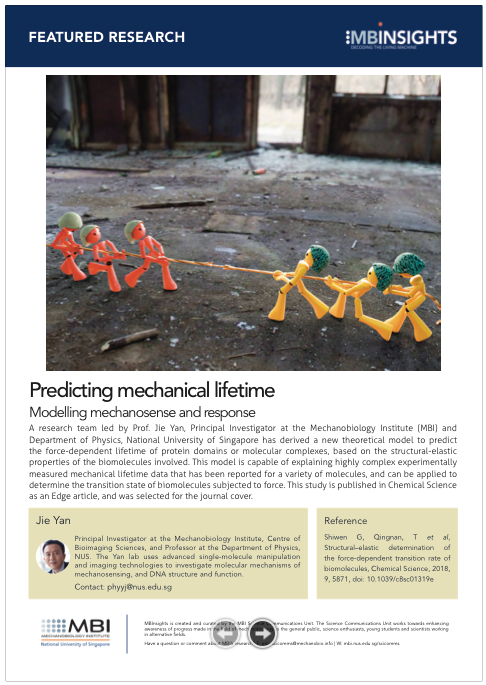
Predicting mechanical lifetime
MBI researchers harness the structural-elastic properties of biomolecules to derive an analytical expression that can predict the force-dependent lifetime of mechanosensitive proteins.
Shiwen G, Qingnan, T et al, Structural–elastic determination of the force-dependent transition rate of biomolecules, Chemical Science, 2018, 9, 5871, doi: 10.1039/c8sc01319e
Download press release.[/fusion_text][fusion_separator style_type="none" top_margin="60px" alignment="center" /][fusion_button color="default" size="medium" stretch="yes" target="_self" icon_position="left" icon_divider="no" animation_type="0" animation_direction="left" animation_speed="1" alignment="left"]About the Lab[/fusion_button][fusion_separator style_type="none" top_margin="20px" alignment="center" /][fusion_title margin_top="" margin_bottom="20px" hide_on_mobile="small-visibility,medium-visibility,large-visibility" class="" id="" size="3" content_align="left" style_type="none" sep_color=""]
The Yan Jie Lab
[/fusion_title][fusion_person name="" title="" picture="https://mbi.closelycoded.site/wp-content/uploads/2016/03/photos-portraits-square-yan-jie.jpg" pic_link="/yan-jie/" linktarget="_self" pic_style="none" hover_type="none" background_color="" content_alignment="" pic_style_color="" pic_bordersize="" pic_bordercolor="" pic_borderradius="round" icon_position="" social_icon_boxed="" social_icon_boxed_radius="" social_icon_color_type="" social_icon_colors="" social_icon_boxed_colors="" social_icon_tooltip="" blogger="" deviantart="" digg="" dribbble="" dropbox="" facebook="" flickr="" forrst="" googleplus="" instagram="" linkedin="" myspace="" paypal="" pinterest="" reddit="" rss="" skype="" soundcloud="" spotify="" tumblr="" twitter="" vimeo="" vk="" whatsapp="" xing="" yahoo="" yelp="" youtube="" email="" show_custom="no" custom_4="" hide_on_mobile="small-visibility,medium-visibility,large-visibility" class="" id="" /][fusion_separator style_type="none" top_margin="20px" alignment="center" /][fusion_text columns="" column_min_width="" column_spacing="" rule_style="default" rule_size="" rule_color="" class="" id=""]The Yan lab uses advanced single-molecule manipulation and imaging technologies to investigate molecular mechanisms of mechanosensing, and DNA structure and function.
Learn more about Prof Yan’s research.[/fusion_text][fusion_separator style_type="none" top_margin="20px" alignment="center" /][fusion_title margin_top="" margin_bottom="20px" hide_on_mobile="small-visibility,medium-visibility,large-visibility" class="" id="" size="3" content_align="left" style_type="none" sep_color=""]
Guo Shiwen Research
[/fusion_title][fusion_person name="" title="" picture="https://mbi.closelycoded.site/wp-content/uploads/2017/04/photos-portraits-quo-shiwen-yanjie.jpg" pic_link="https://mbi.closelycoded.site/mechanisms/guo-shiwen/" linktarget="_self" pic_style="none" hover_type="none" background_color="" content_alignment="" pic_style_color="" pic_bordersize="" pic_bordercolor="" pic_borderradius="round" icon_position="" social_icon_boxed="" social_icon_boxed_radius="" social_icon_color_type="" social_icon_colors="" social_icon_boxed_colors="" social_icon_tooltip="" blogger="" deviantart="" digg="" dribbble="" dropbox="" facebook="" flickr="" forrst="" googleplus="" instagram="" linkedin="" myspace="" paypal="" pinterest="" reddit="" rss="" skype="" soundcloud="" spotify="" tumblr="" twitter="" vimeo="" vk="" whatsapp="" xing="" yahoo="" yelp="" youtube="" email="" show_custom="no" custom_4="" hide_on_mobile="small-visibility,medium-visibility,large-visibility" class="" id="" /][fusion_separator style_type="none" top_margin="20px" alignment="center" /][fusion_text columns="" column_min_width="" column_spacing="" rule_style="default" rule_size="" rule_color="" class="" id=""] Learn more about Guo Shiwen’s research.[/fusion_text][fusion_separator style_type=”none” top_margin=”60px” alignment=”center” /][fusion_button color=”default” size=”medium” stretch=”yes” target=”_self” icon_position=”left” icon_divider=”no” animation_type=”0″ animation_direction=”left” animation_speed=”1″ alignment=”left”]Related Articles[/fusion_button][fusion_blog layout=”large” blog_grid_columns=”2″ blog_grid_column_spacing=”0″ blog_masonry_grid_ratio=”” blog_masonry_width_double=”” equal_heights=”no” number_posts=”2″ offset=”1″ pull_by=”category” cat_slug=”yan-jie-lab,yu-m-research” exclude_cats=”jobs” tag_slug=”” exclude_tags=”” orderby=”date” order=”DESC” thumbnail=”yes” title=”yes” title_link=”yes” content_alignment=”” excerpt=”yes” excerpt_length=”24″ strip_html=”yes” meta_all=”yes” meta_author=”no” meta_categories=”yes” meta_comments=”no” meta_date=”yes” meta_link=”yes” meta_tags=”no” scrolling=”no” grid_box_color=”” grid_element_color=”” grid_separator_style_type=”” grid_separator_color=”” padding_top=”” padding_right=”” padding_bottom=”” padding_left=”” hide_on_mobile=”small-visibility,medium-visibility,large-visibility” class=”” id=”” /][/fusion_builder_column][/fusion_builder_row][/fusion_builder_container]