
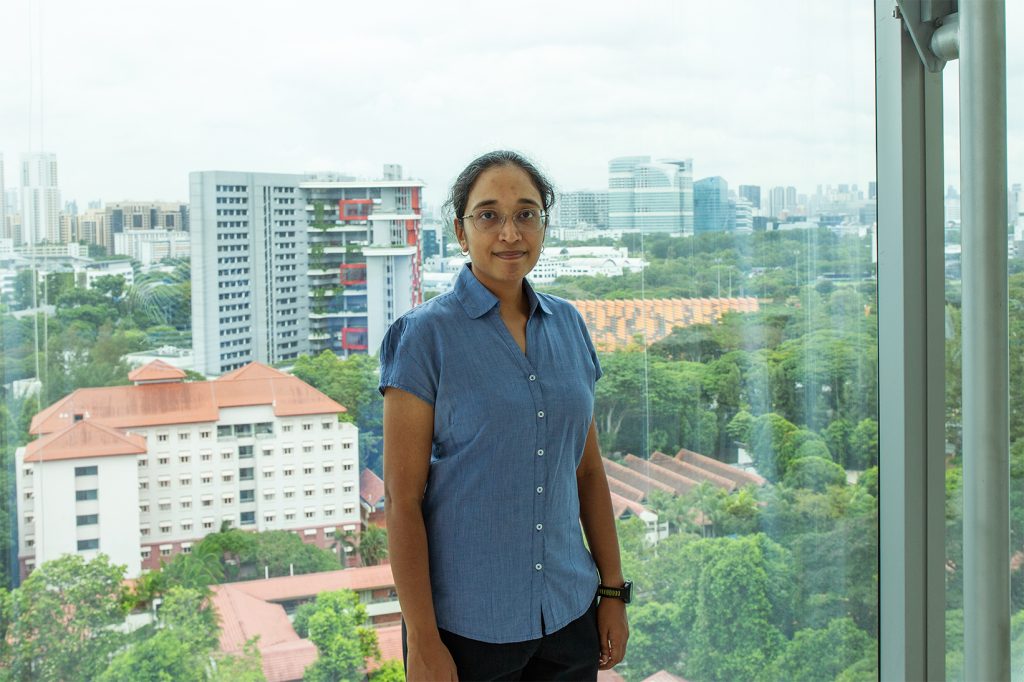
A warm welcome to Dr Shailaja Seetharaman who will leading the Vascular Mechano-Medicine lab as a MBI Principal Investigator–with a joint appointment as an Assistant Professor in the Department of Physiology, NUS School of Medicine.
Prior to this, she was a postdoctoral fellow in the Department of Physics at the University of Chicago. She received her PhD in Cell and Developmental Biology from Institut Pasteur, Paris, and her Master’s in Biomedical and Molecular Sciences from King’s College London. Her work has been supported by the American Heart Association, Eric and Wendy Schmidt AI in Science, and Yen Postdoctoral Fellowships, and the Marie Curie and the Fondation pour la Recherche Médicale PhD Fellowships.
Shailaja’s research at MBI will decode the mechano-chemical feedback mechanisms that govern vascular function in health and disease. In particular, her interests lie in understanding how endothelial cells sense and respond to mechanical forces, including fluid shear stress, stretch, and substrate curvature, and how such mechanosensing goes awry to drive cardio- and cerebro-vascular dysfunction in aging-related diseases.
Shailaja is currently recruiting graduate students to join her lab. Please contact her via email or visit her website for more details!